
Your customers still search before they buy. But more and more often, the first thing they see is an AI-written summary rather than a list of ten links, and many of them never scroll past it. If your site isn't one of the sources those answers draw from, you are invisible at the exact moment someone is deciding.
The good news: the work that earns visibility in AI search is mostly the same work that has always earned rankings, done more rigorously. This guide explains what has actually changed, what hasn't, and a practical checklist you can apply to your own site this quarter.
What changed in search (and what didn't)
Three shifts define search in 2026:
- AI answers sit on top of the results. Google's AI Overviews summarise an answer at the top of many results pages, with links to the sources it used. AI Mode goes further: a conversational, follow-up-friendly search experience that Google rolled out in India during 2025. (If you still see "SGE" in older guides, that was the experimental name; it no longer exists as such.)
- Search is no longer one engine. ChatGPT search, Perplexity, Microsoft Copilot and Gemini all answer questions and cite websites. Your buyers use several of them, often without thinking of it as "searching".
- Matching keywords is not enough. Modern systems understand what a query means. When someone types "best noise-cancelling headphones", search knows they want comparisons and reviews, not the history of headphones.
What didn't change is just as important. Google has said plainly that there is no special trick for appearing in AI Overviews or AI Mode: a page needs to be indexed, eligible to show a snippet, and genuinely useful. Its guidance on AI features points straight back to standard SEO best practices. AI search didn't kill SEO. It raised the bar for it.
The three questions every page must answer
Strip away the jargon and every page you publish has to answer three questions convincingly:
- What does this page cover? Is the topic obvious from the title, headings and first paragraph, to a person and to a machine?
- Why should anyone trust it? Who wrote it, what experience does it draw on, and is it accurate and current?
- Is it better than the alternatives? Does it solve the searcher's problem more completely or more clearly than the pages already ranking?
A page that gets all three right tends to rank and tends to be cited in AI answers. Miss even one and it usually stays buried, however well "optimised" it looks.
Start with search intent, not keywords
Keyword density is a relic. What matters is whether your page gives the searcher what they came for. Someone searching "best CRM for small businesses" wants options, comparisons and rough pricing, not a 2,000-word definition of CRM.
Before writing or rewriting any page, ask: what does this person actually need to do next? Then match the format to the intent:
| Intent | What the searcher wants | Content that fits |
|---|---|---|
| Informational | To understand or learn something | Guides, explainers, how-tos |
| Commercial | To compare options before deciding | Comparisons, "best X for Y", reviews, case-style walkthroughs |
| Transactional | To buy, book or sign up now | Service pages, product pages, pricing, clear calls to action |
| Local | A provider nearby | Location pages, a complete Google Business Profile |
A quick test: search your target phrase and look at what already ranks and what the AI Overview says. If the results are all comparison articles and you're planning a sales page, you're fighting the intent instead of serving it.
When you answer the real question completely, the right keywords and their variations appear naturally. That completeness also matters for AI search, which tends to break a complex question into several sub-questions and pull answers from different pages. Content that covers the obvious follow-ups ("how much does it cost?", "how long does it take?", "what are the alternatives?") gives those systems more to work with.
Turn real customer questions into your headings
A simple exercise that works for almost any business:
- List your main products or services.
- For each, write down five to seven questions customers actually ask. Your sales emails, WhatsApp chats and call notes are the best source.
- Use the clearest wording of each question as a heading (H2 or H3).
- Answer it directly in the first two or three sentences under that heading, then add detail, examples and caveats.
The difference is easy to see. "Many businesses wonder about the cost of a website. There are various factors to consider..." buries the answer. "A basic five-page business website usually costs less than a custom web app; the main cost drivers are the number of templates, integrations and who writes the content. Here's how each one affects the price..." answers first and earns the reader's attention for the detail.
 Photo: Shixart1985 · CC BY 2.0 · Wikimedia Commons
Build topical authority with content clusters
Search engines look at your site as a whole, not just individual pages. A site that publishes consistently and deeply on a focused set of topics sends a much clearer signal than one that writes about everything.
The most reliable way to do this is the pillar-and-cluster model:
- One pillar page covers a core topic broadly, for example "SEO for e-commerce stores".
- Supporting articles go deep on specific sub-topics: product page optimisation, category structure, handling out-of-stock pages, site speed for large catalogues.
- Every supporting article links back to the pillar, and the pillar links out to each of them. Related supporting articles link to one another where it helps the reader.
For an SMB, this usually means publishing less but more deliberately. Pick the three or four topics your customers care about most, map the questions they ask, and cover those thoroughly before branching out. If you want help mapping topics to real search demand, that's exactly what a content strategy engagement is for.
On-page fundamentals that still work
None of these are new, and all of them still matter, because they help both people and machines understand a page quickly:
- Title tags that are clear, specific and worth clicking. Lead with the topic, not your brand name.
- Meta descriptions that summarise the page's value. They don't directly affect rankings, but they influence whether people click.
- A logical heading structure: one H1, then H2s and H3s that read like an outline of the answer.
- A direct answer early on. If the page answers a question, state the answer in the first paragraph or two, then expand. This helps readers and makes the passage easy for AI systems to quote.
- Descriptive image alt text that says what the image shows.
- Internal links with descriptive anchor text to related pages on your site.
- Structured data (schema.org markup) for your organisation, articles, products, reviews and local business details where relevant. It won't guarantee a rich result, but it removes ambiguity about what your page is.
A minimal Organization block for your homepage looks like this. Use your real details, and list your official profiles in sameAs so search engines can connect them to your site:
<script type="application/ld+json">
{
  "@context": "https://schema.org",
  "@type": "Organization",
  "name": "Your Business Name",
  "url": "https://www.example.com/",
  "logo": "https://www.example.com/logo.png",
  "description": "What you do, for whom, in one clear sentence.",
  "sameAs": [
    "https://www.linkedin.com/company/example",
    "https://www.instagram.com/example"
  ]
}
</script>
Article pages can then reference the same organisation as publisher, with a named author, datePublished and dateModified. Check your markup with Google's Rich Results Test and watch the enhancement reports in Search Console for errors.
Our on-page SEO audits start with exactly this list, because fixing the basics across key pages is often the quickest win available.
Technical SEO you can't ignore
Brilliant content fails if search engines can't crawl, render and index it, and technical problems tend to kill rankings silently. Check these regularly:
- XML sitemap submitted in Google Search Console and Bing Webmaster Tools, containing only live, indexable URLs.
- robots.txt that doesn't accidentally block important pages, CSS or JavaScript.
- Canonical tags pointing to the preferred version of duplicate or near-duplicate pages.
- HTTPS everywhere, with no mixed-content warnings.
- Mobile-friendly layout. Google indexes the mobile version of your site, so that is the version that counts.
- Core Web Vitals: Largest Contentful Paint (LCP), Interaction to Next Paint (INP) and Cumulative Layout Shift (CLS). INP replaced First Input Delay as the responsiveness metric in 2024, so older audits that still report FID are out of date. web.dev's Core Web Vitals guide explains the thresholds.
- Content that renders without heavy client-side JavaScript, where possible. Not every AI crawler renders JavaScript as thoroughly as Googlebot, so key text should exist in the initial HTML.
Two settings are worth a look specifically because of AI search:
- AI crawlers in robots.txt. Decide deliberately which bots you allow. For example, blocking OpenAI's
OAI-SearchBotorPerplexityBotcan keep you out of those tools' answers. Note that Google'sGoogle-Extendedtoken controls use of your content for Gemini model training; it does not affect Google Search or AI Overviews. - Snippet controls.
nosnippetandmax-snippetlimit how much of your page Google can show, and they also apply to AI features. Use them only where you have a clear reason.
If this list feels daunting, a technical SEO audit will surface the issues that actually matter on your site and rank them by impact.
Backlinks still matter: quality over quantity
A link from another site is still a recommendation, and recommendations from trusted sources still carry weight. What has changed is tolerance for shortcuts. One link from a respected industry publication, association or news site is worth far more than hundreds from low-quality directories or paid link networks, and the latter can actively hurt you.
The sustainable way to earn links is to publish things people genuinely want to reference:
- Original data or research, even small-scale, such as a survey of your customers or an analysis of trends in your niche.
- Comprehensive, practical guides that become the go-to resource on a topic.
- Free tools, templates and calculators relevant to your audience.
- Expert commentary offered to journalists and industry publications.
Being mentioned and cited across the web also shapes how AI assistants describe your brand, so this work pays off twice.
E-E-A-T: show experience, expertise and trust
Google's quality guidelines describe E-E-A-T: Experience, Expertise, Authoritativeness and Trustworthiness, with trust at the centre. It isn't a single ranking factor or score. It's a description of what Google's systems try to reward, and it maps neatly onto what readers look for anyway.
Practical ways to demonstrate it:
- Experience: share what you have actually done or tested. Specific details, screenshots, process notes and honest trade-offs are hard to fake and easy to recognise.
- Expertise: be accurate. Use clear author bylines and short bios that state relevant credentials.
- Authoritativeness: earn mentions and links from respected sources in your field, as above.
- Trust: cite sources, show who runs the business and how to contact you, keep content up to date with visible review dates, and correct errors promptly.
Google's own guide to creating helpful, reliable, people-first content includes a useful self-assessment checklist.
Can AI-written content rank?
Yes, if it is genuinely helpful. Google's position is that it judges the quality of content, not how it was produced. What it does act against is scaled content abuse: mass-producing pages mainly to manipulate rankings, whether by AI, by people, or both.
In practice, unedited AI drafts rarely rank well for long, because they say what everything else already says and contain no first-hand experience. The workflow we recommend:
- Use AI to speed up research, outline structure and produce a rough first draft.
- Add what only you can add: your experience, examples, opinions, local context and data.
- Fact-check every claim, number and recommendation.
- Edit for clarity and cut anything generic.
AI is a fast assistant. It is not a substitute for expertise.
Keep your best content current
Content decays: prices change, tools get renamed, screenshots go stale and competitors publish something better. A light, regular routine beats an occasional panic rewrite:
- Every few months, review your most important pages: fix outdated facts and broken links, refresh examples and screenshots, and fill gaps that new customer questions have revealed. Update the visible "last updated" date only when you have made a real change.
- Once a year, reassess each cornerstone page against what currently ranks: does its structure still match search intent, or does it need a proper rewrite or merging with a weaker page on the same topic?
- Keep a simple tracker (a spreadsheet is fine) with each page's last review date, next review date and key metrics, and prioritise the pages that bring in the most impressions and enquiries.
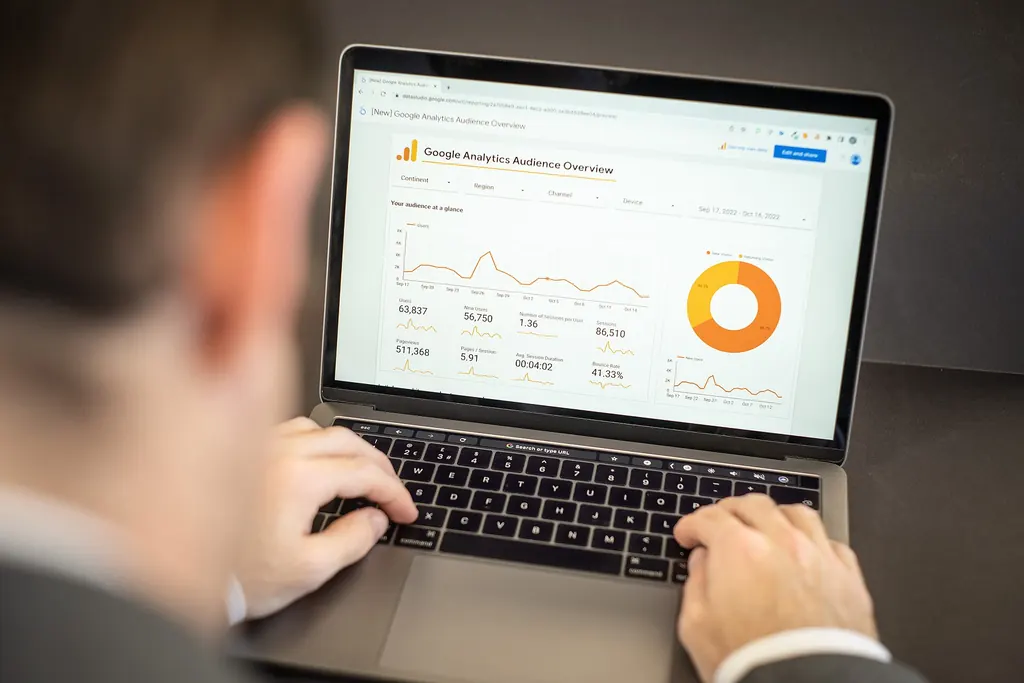 Photo: Zuko.io Images · CC BY 2.0 · Wikimedia Commons
Measuring success when clicks are harder to get
AI answers satisfy some searches without a click, so raw traffic alone is no longer a complete picture. Track a broader set of signals:
- Impressions and average position in Google Search Console, alongside clicks. At the time of writing, Google includes AI Overview and AI Mode activity in the standard Performance report rather than as a separate filter.
- Conversions from organic traffic: enquiries, calls, sign-ups and sales. Fewer but better-qualified visits can be a good trade.
- Branded search volume. If more people search for your name, your visibility is working even where clicks aren't tracked.
- AI citations. Periodically ask ChatGPT, Perplexity, Gemini and Google's AI Mode the questions your customers ask, and note whether and how your brand is cited.
- Referral traffic from AI tools in your analytics, from sources such as chatgpt.com and perplexity.ai.
Key takeaways: your 2026 SEO checklist
- Every important page answers: what it covers, why to trust it, and why it beats the alternatives.
- Content format matches search intent (check what currently ranks before writing).
- Core topics are organised into pillar pages with linked supporting articles.
- Titles, headings, direct answers, internal links and structured data are in place on key pages.
- Sitemap, robots.txt, canonicals, HTTPS, mobile layout and Core Web Vitals (LCP, INP, CLS) are healthy.
- AI crawler access and snippet settings are deliberate choices, not accidents.
- Links are earned through genuinely useful resources, not bought.
- Authors, sources and update dates are visible; cornerstone content is refreshed regularly.
- AI-assisted drafts are always edited, enriched with real experience and fact-checked.
- Success is measured by impressions, conversions, branded search and AI citations, not clicks alone.
The sites winning in 2026 aren't the ones publishing the most. They're the ones publishing the best and keeping their foundations solid.
If you'd like a clear-eyed view of where your site stands, our SEO & growth team will be happy to help turn this checklist into a plan. Book a free consultation for a no-obligation chat with TrackMy Tech, and if it's a fit, we can also help make your website DPDP-compliant.